
I arrived at Fundación Santa Fe de Bogotá before sunrise, traveling through a city that was already fully awake. My appointment was scheduled early, 7:00 a.m. and it quickly became clear that Bogotá runs on a different rhythm. This was not a hospital just opening its doors for the day; it was already in motion.
I was directed to the Edificio de Ambulancias, a striking structure marked by red tiled architecture and thoughtful design choices. Inside, the space shifted to cool green-blue tones making it feel fresh, calm, and intentionally designed. It didn’t feel sterile or rushed. It felt considered.
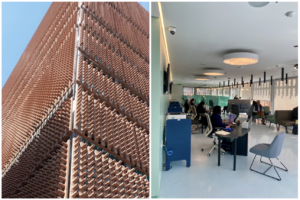
That first impression turned out to be consistent with everything that followed.
Section 1: Nutrition & Body Composition – Establishing a Baseline
The Medicina del Ejercicio circuit began with a single, dedicated nutrition specialist who guided the entire first section of the evaluation.
After a brief check-in and ticketing process, the session started calmly and efficiently. The approach was practical and respectful, focused on understanding the body as it is today rather than prescribing immediate fixes.
Body composition, done properly
Rather than relying on estimates, the assessment used a professional body composition analysis system (InBody-style). The process was simple but precise: standing barefoot on metal sensors while holding the hand grips, allowing the machine to generate a full-body reading.
The resulting report provided a clear, structured overview, including:
- Análisis de composición corporal
- Relación músculo-grasa
- Distribución segmental de masa magra y grasa
- Indicadores de obesidad
- Historial de composición corporal
The emphasis was not just on weight, but on how the body is composed and how that composition is distributed.
Anthropometric measurements
In addition to the machine-based analysis, the same specialist conducted detailed physical measurements of the arms, abdomen, and legs using a consistent, methodical technique. Clear anatomical reference points were used to ensure accuracy—an often overlooked but critical detail in baseline assessments.
Nutrition, visualized
One of the most effective elements of this section was how nutrition was communicated visually.
A plato saludable (healthy plate model), sized like a real plate, was used to demonstrate balance at a glance:
- Approximately half the plate dedicated to fruits and vegetables
- The remaining portions divided between protein and carbohydrates
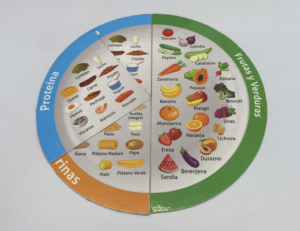
This was reinforced with thoughtfully designed take-home materials, including a “build-your-own Buddha bowl” guide that encouraged creativity within structure:
- choose a base
- add grains
- layer vegetables
- include protein
Rather than rigid meal plans, the focus was on practical, repeatable habits.
Section 2: Functional Assessment – Balance, Mobility, and Core Stability
The next phase of the circuit focused on functional movement, how the body stabilizes, balances, and adapts during controlled motion.
This assessment emphasized:
- Single-leg balance
- Core stability in standing and grounded positions
- Controlled transitions and posture
- General flexibility across joints
Balance was tested multiple times and in different contexts, underscoring that stability is dynamic and influenced by fatigue, inflammation, and overall condition.
The approach remained observational rather than performative. The goal was to identify patterns, not to push limits.
Section 3: Strength & Movement Screening – Load and Control
The evaluation then transitioned into a more explicit sports medicine-oriented screening, still conducted one-on-one.
This included:
- Squats and foundational lower-body movements
- Core engagement under load
- Upper-body strength and control (including push-up variations)
- Plank and reverse-plank style holds
Each movement was used diagnostically, to observe coordination, endurance, and form—rather than as a fitness challenge. The progression from balance to strength felt intentional and cohesive.
Section 4: Flexibility, Mobility, and Pressure Mapping
Flexibility and mobility were then assessed more directly, including:
- Upper- and lower-limb range of motion
- Joint mobility checks
- Targeted pressure-point palpation to identify tension patterns
Rather than isolating single muscles, this section examined how restrictions appear across the body as a system.
Section 5: Performance Metrics & Asymmetry Analysis
The final stage introduced instrumented performance testing.
After a brief warm-up on a stationary bicycle, force output was measured using specialized equipment capable of quantifying strength in newtons, allowing for precise left-right comparison.
Results were displayed visually through clear graphs and explained in real time, highlighting:
- Strength asymmetries
- Side-to-side imbalances
- Areas requiring targeted training or correction
This data-driven close tied together everything observed earlier in the circuit.
Section 6: Follow-Up and Continuity of Care
Following the assessment, detailed reports and educational materials were sent electronically, consolidating the findings from each phase and outlining next steps.
The experience extended beyond the visit itself, reinforcing continuity rather than one-off evaluation.
Closing Reflection
What distinguishes this Medicina del Ejercicio program is not a single test or tool, but how intentionally each component is connected.
From nutrition and body composition to movement, strength, and quantified performance metrics, the circuit reflects a preventive care model that is:
- integrated
- human-centered
- data-informed without being impersonal
It is a reminder that preventive care works best when it is thoughtfully designed and clearly communicated.
Program Information
- Program: Medicina del Ejercicio, Fundación Santa Fe de Bogotá
- WhatsApp: 322 822 45 26
✨🐉 Field Notes from the DragonLine Tour on 1/22/2026 in Bogota, Colombia
